
ESAT, TMUA and TARA results 2026: what your score means (2027 entry)

Quantum Pathways
•Updated 18 November 2026 for 2027 entry
•AdmissionsResults are out (16 November 2026): what past candidates scored, how the 1.0 to 9.0 scale is built, and what to do next with your score.
Results are out (16 November 2026). October results are now in candidates’ UAT-UK accounts.
What scores got interviews and offers last year? See the published data from Imperial, Cambridge, LSE and Warwick →
The short answer. October 2026 results for the ESAT, TMUA and TARA reached candidates' UAT-UK accounts on Monday 16 November 2026. Scores run from 1.0 to 9.0. The middle October candidate scores 4.5, and the top 10% score 7.0 or more. There is no pass mark. Each university decides what score it needs, and reads it alongside the rest of the application. Below we show what candidates scored in previous years, how the scale works, and what to do next. We'll tell you honestly where your student stands.
When do ESAT, TMUA and TARA results come out?
UAT-UK released October results on Monday 16 November 2026. Universities named on your UCAS application receive scores automatically, shortly after the test. Results for the January 2027 sitting arrive on 8 February 2027. All key admissions dates are on our key dates page.
What is a good TMUA score?
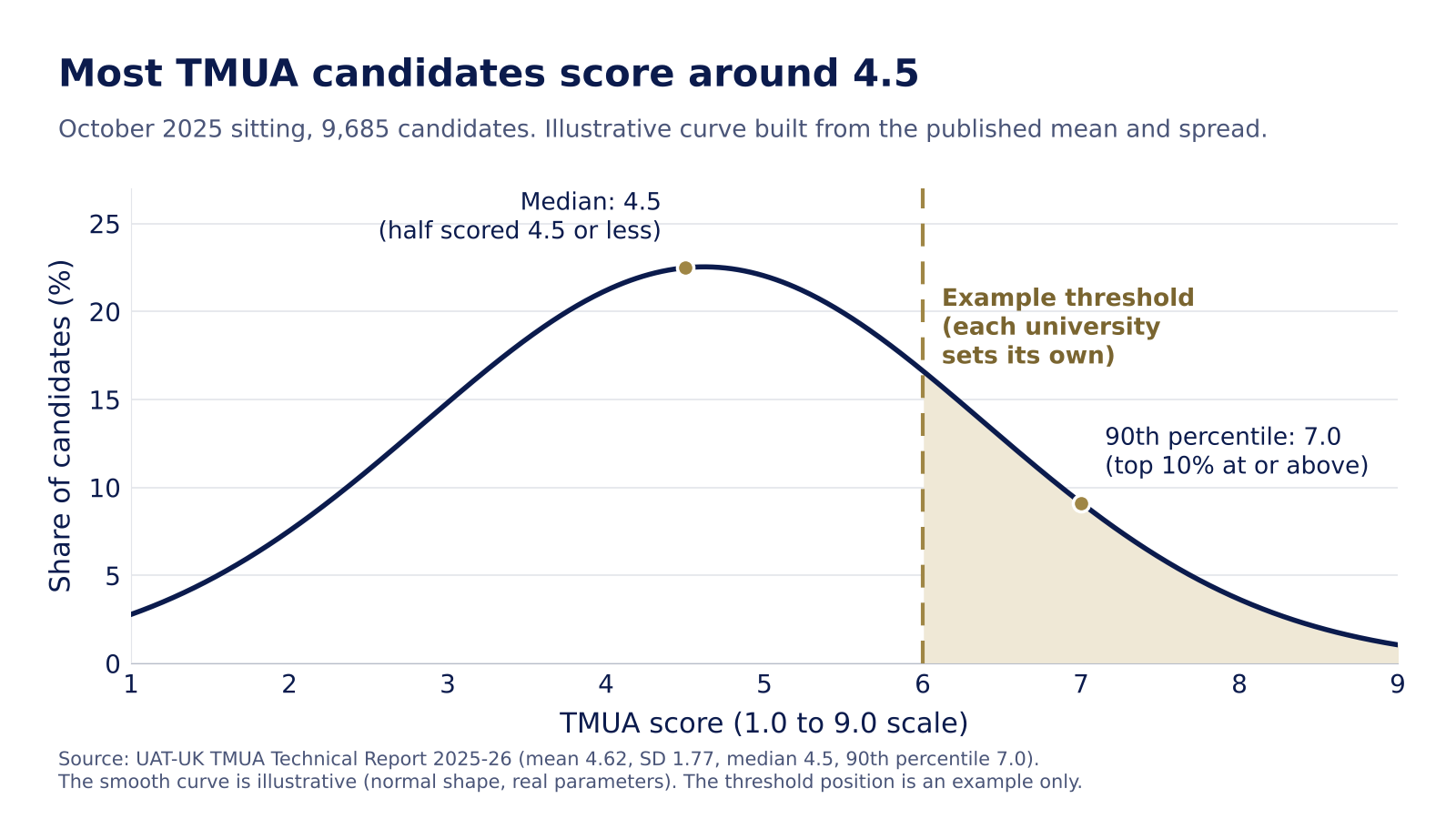
Read any score against everyone else who sat the test. UAT-UK's technical reports publish this.
TMUA scores in the last two cycles (official UAT-UK data)
| Cycle | Sitting | Candidates | Average | 25th percentile | Median | 75th percentile | 90th percentile |
|---|---|---|---|---|---|---|---|
| 2024-25 | October 2024 | 8,987 | 4.58 | 3.3 | 4.5 | 5.7 | 7.0 |
| 2024-25 | January 2025 | 4,868 | 3.51 | 2.4 | 3.3 | 4.4 | 5.4 |
| 2025-26 | October 2025 | 9,685 | 4.62 | 3.3 | 4.5 | 5.8 | 7.0 |
| 2025-26 | January 2026 | 6,407 | 3.78 | 2.7 | 3.6 | 4.6 | 5.9 |
Group: all candidates who sat each sitting. Source: UAT-UK TMUA Technical Reports 2024-25 and 2025-26, Table 4.
So, for the October sitting:
- 4.5 is the middle. Half of candidates scored at or below it.
- 5.8 put you in roughly the top quarter in 2025.
- 7.0 put you in the top 10%.
"Good" depends on the course. A score in the top quarter is strong for most TMUA courses. The most competitive courses see many applicants in the top 10%.
What is a good ESAT score?
The ESAT gives a separate score for each module. Each module is scaled on its own, with the same anchors as the TMUA.
ESAT October 2025 scores by module (official UAT-UK data)
| Module | Candidates (October 2025) | Average | Median | 75th percentile | 90th percentile |
|---|---|---|---|---|---|
| Mathematics 1 | 10,116 | 4.73 | 4.5 | 5.6 | 7.0 |
| Mathematics 2 | 8,082 | 4.73 | 4.5 | 5.7 | 7.0 |
| Physics | 7,717 | 4.58 | 4.5 | 5.6 | 7.0 |
| Chemistry | 2,814 | 4.72 | 4.5 | 5.7 | 7.0 |
| Biology | 1,531 | 4.46 | 4.5 | 5.7 | 7.0 |
Source: UAT-UK ESAT Technical Report 2025-26, Table 5.
One college has published how scores related to outcomes. For Engineering at Peterhouse, Cambridge, in the 2024-25 cycle, 95 people applied, 56 were interviewed and 15 received offers. Offer holders averaged 6.1 on the ESAT. Those without offers averaged 4.7. No applicant scoring below 4.0 received an offer. This is one college's Freedom of Information answer, so treat it as an example, not a rule.
What is a good TARA score?
The TARA reports two scores: Critical Thinking and Problem Solving. The Writing Task is not scored. Your answer is passed to the universities that require it, to use as they choose.
TARA 2025-26 scores (official UAT-UK data)
| Module | Sitting | Candidates | Average | Median | 90th percentile |
|---|---|---|---|---|---|
| Critical Thinking | October 2025 | 976 | 4.46 | 4.5 | 7.0 |
| Critical Thinking | January 2026 | 1,650 | 4.06 | 4.0 | 6.6 |
| Problem Solving | October 2025 | 976 | 4.66 | 4.5 | 7.0 |
| Problem Solving | January 2026 | 1,650 | 4.76 | 4.8 | 7.0 |
Source: UAT-UK TARA Technical Report 2025-26, Table 4. 2025-26 was the TARA's first cycle, so there is no earlier year to compare.
Do admissions test scores go up every year?
Many people expect scores to rise year on year. The published data does not show that. The reason is built into the scale.
Each year, UAT-UK fixes the October median at 4.5 and the 90th percentile at 7.0. So October scores look almost identical from one year to the next. The 2025-26 TMUA report says its scores "cannot be directly compared" with the previous cycle.

What has gone up is the number of candidates:
| Test | 2024-25 candidates | 2025-26 candidates | Change |
|---|---|---|---|
| TMUA (both sittings) | 13,855 | 16,092 | up 16% |
| ESAT Mathematics 1 (both sittings) | 11,919 | 14,193 | up 19% |
Source: UAT-UK TMUA and ESAT Technical Reports 2024-25 and 2025-26.
Older scores can mislead too. The TMUA scale changed in 2024. Durham University states that "a score of 6.5 from 2023 will equate to a score of 5.0 from 2024 onwards". A 2023 score cannot be compared with a 2026 score.
Our honest reading: scores do not rise automatically, but more people now sit these tests. Universities do not publish their thresholds, so the data cannot show whether the bar for interview is rising.
How is the TMUA scored?
The TMUA has two papers of 20 multiple-choice questions, 75 minutes each. You get one overall score. UAT-UK equates and scales Papers 1 and 2 together. Wrong answers lose no marks.
Scoring works in three steps, as UAT-UK describes them:
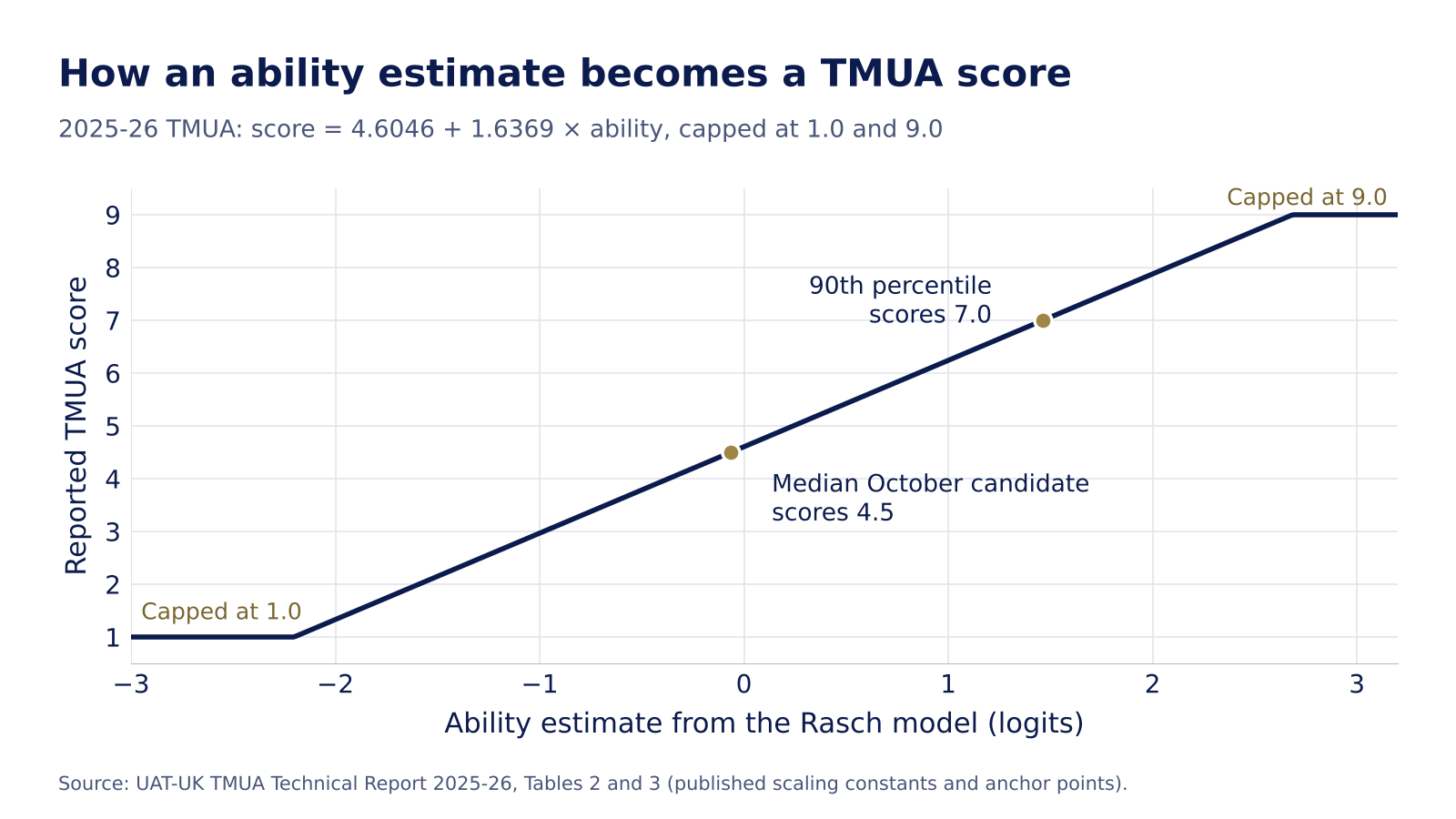
- Ability estimate. A statistical method called the Rasch model turns your answers into an ability estimate. It takes into account how hard each question was.
- Equating. Candidates sit different versions of the test. Equating puts everyone on one scale, so a harder version is not a disadvantage.
- Scaling. The ability estimate is converted to the 1.0 to 9.0 scale. The October median becomes 4.5 and the 90th percentile becomes 7.0. January scores use the same conversion.
A worked example. For 2025-26, UAT-UK published the conversion: score = 4.6046 + 1.6369 × ability estimate. Scores are capped at 1.0 and 9.0.
- A candidate with an ability estimate of 0 scores 4.6.
- A candidate with an ability estimate of 1.0 scores 4.6046 + 1.6369 = 6.24, reported as 6.2.
- A candidate with an ability estimate of 1.5 scores 7.06, reported as 7.1.
UAT-UK does not publish a table turning raw marks into scores. Within one version of the test, more correct answers always means a higher ability estimate.
How is the ESAT scored?
The ESAT has five modules: Mathematics 1, Mathematics 2, Physics, Chemistry and Biology. Each has 27 questions in 40 minutes. You get a separate score for each module you take. Each module is equated and scaled separately, using the same method as the TMUA. There is no overall ESAT score.
How is the TARA scored?
The TARA has three modules of 40 minutes. Critical Thinking and Problem Solving each have 22 multiple-choice questions and get their own score. The Writing Task is unscored. UAT-UK passes your answer to the universities you apply to that require the test.
Why does every extra mark matter?
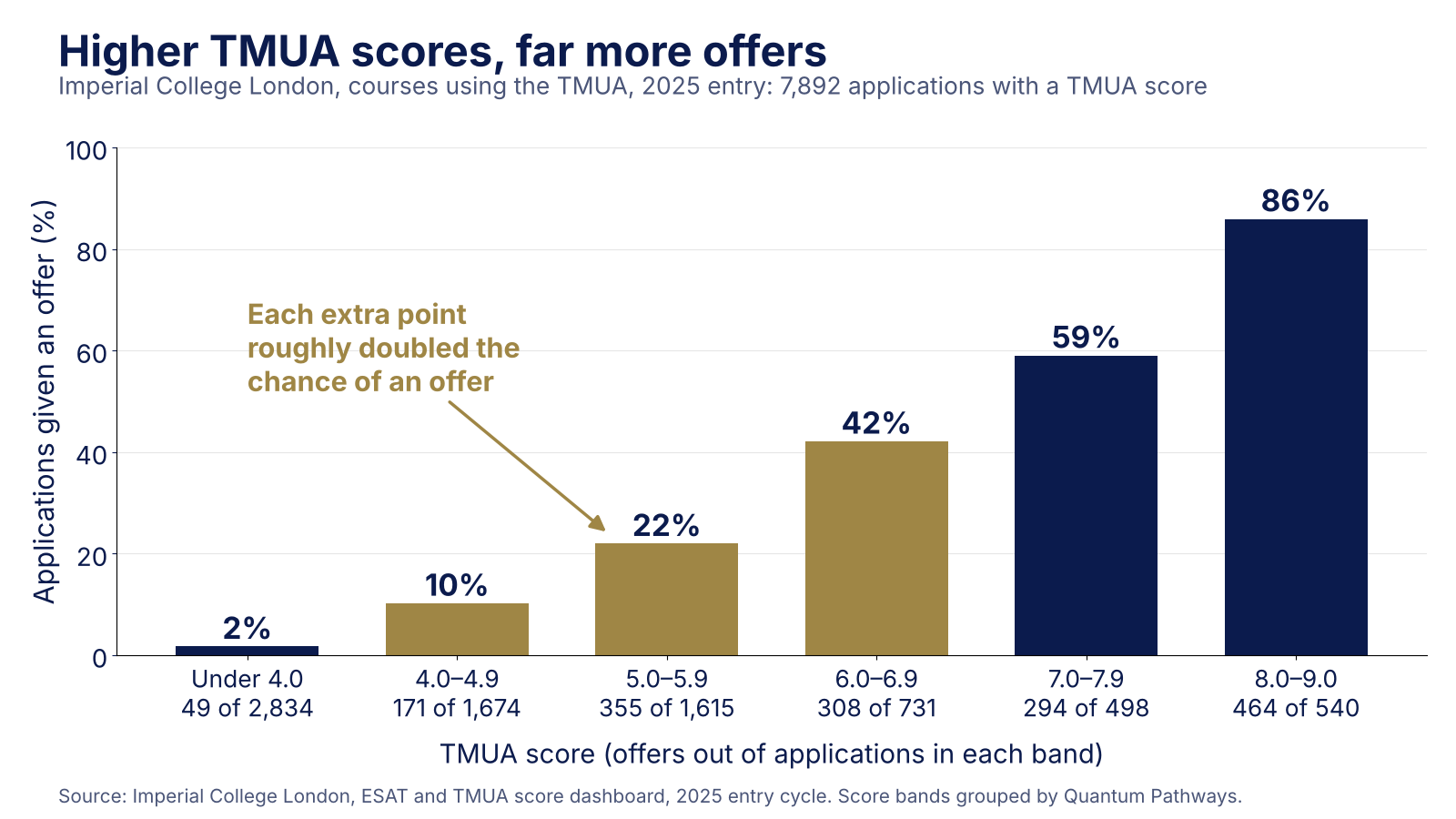
Because a point on the scale can double your chances. Imperial publishes the TMUA scores and outcomes of every applicant to its courses that use the test. For 2025 entry, 7,892 applications had a TMUA score.
| TMUA score | Applications | Offers | Offer rate |
|---|---|---|---|
| Under 4.0 | 2,834 | 49 | 2% |
| 4.0 to 4.9 | 1,674 | 171 | 10% |
| 5.0 to 5.9 | 1,615 | 355 | 22% |
| 6.0 to 6.9 | 731 | 308 | 42% |
| 7.0 to 7.9 | 498 | 294 | 59% |
| 8.0 to 9.0 | 540 | 464 | 86% |
Between 4 and 7, each extra point roughly doubled the chance of an offer. That is the middle of the curve, where most candidates sit, so a small rise there passes the most people.
Oxford's Mathematics Admissions Test showed the same pattern. Oxford Maths used the MAT until October 2025 and moves to the TMUA this year. In the 2023 round, about a quarter of applicants scoring 61 to 65 out of 100 were shortlisted for interview. At 66 to 70, it was about half.
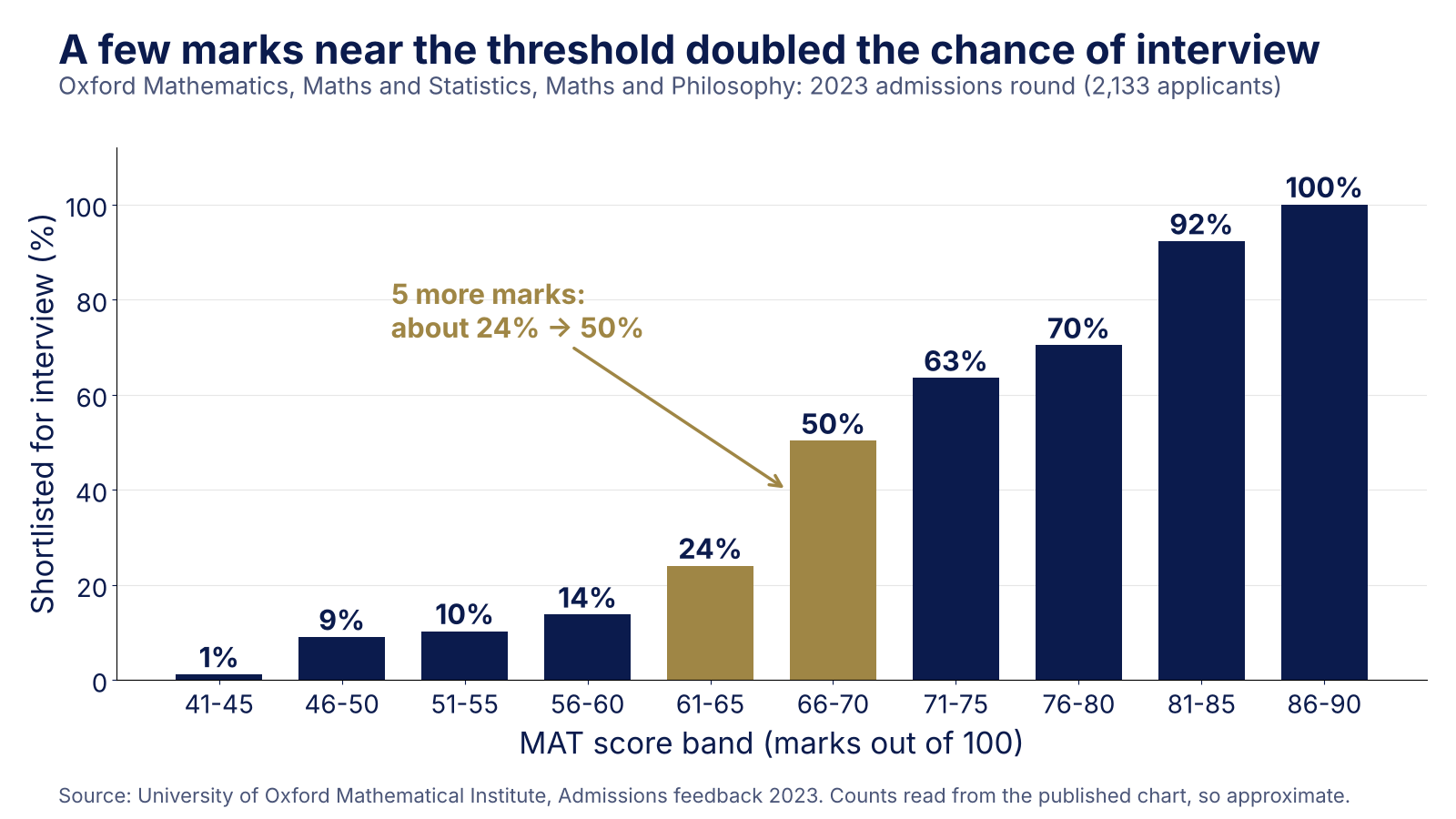
A score is never the only thing that counts. Universities read it alongside your grades, personal statement and context. But near the threshold, a few marks can decide whether you are invited to interview. So whatever score your student is aiming for, aim a little higher. Not out of worry, but because the extra margin is real.
Should you book the January sitting?
Start with one rule from UAT-UK: you can take each test only once in an application cycle. If you sat in October 2026, you cannot resit in January 2027 for 2027 entry.
If you have not sat yet, it depends where you are applying:
| University | January 2027 sitting for 2027 entry? |
|---|---|
| Oxford | No. All undergraduate applicants must sit in October 2026. Applicants to the Astrophoria Foundation Year can sit in October or January. |
| Cambridge | No, for the 15 October deadline. Mature applicants applying in the January round can sit in January. |
| Imperial | Yes. You can sit in October or January. Only your first score is considered. |
| LSE | Yes. "Either sitting is acceptable". LSE accepts only your first sitting in a cycle. |
| Other universities | Check each course page. UAT-UK says non-Oxbridge candidates can choose either sitting. |
January dates for 2027 entry:
- Access arrangements deadline: 7 December 2026, 6pm GMT
- Bursary deadline: 14 December 2026, 6pm GMT
- Booking closes: 21 December 2026, 6pm GMT
- Test window: 4 to 8 January 2027
- Results: 8 February 2027
January candidates are scored on the same scale as October candidates. In the last two cycles, January medians were lower than October medians. UAT-UK says that, outside Oxford and Cambridge, there is "no advantage" to either sitting. More detail is in our admissions tests guide and the test-by-test guides.
What should you do after getting your score?
Compare the score with the October percentiles above. Thresholds differ by course and are rarely published, so these bands are a rough guide only. For the most competitive courses, the bar sits higher.
Well above the likely threshold (for example, 7.0 or higher). You are in the top 10% of October candidates. Shift your energy to interviews. Oxford tells applicants whether they are shortlisted from the end of November to the beginning of December. Cambridge sends most interview invitations in November, and some in early December. Cambridge interviews run from 7 to 18 December 2026. Start with our interview preparation.
Around the likely threshold (for example, between 4.5 and 7.0). Your application is still being read as a whole. Universities weigh scores with grades, the personal statement, the reference and context. Prepare for interview as if one is coming.
Below the likely threshold (for example, under 4.5). A lower score does not end an application. Imperial states that "a low score does not mean that your application will be unsuccessful". Oxford reads test scores alongside contextual data. Check your other choices, and keep working on your grades. Those still matter for every offer.
How do universities use these scores?
There is no pass mark. Each university sets its own threshold, and most do not publish it. In general, applicants below a course's threshold are not invited to interview. Contextual information is considered too.
Some examples from official pages:
- Oxford Physics: "The primary shortlisting criterion is the ESAT score, interpreted in the light of contextual data". It shortlists around 2.5 applicants per place.
- Oxford, all courses: applicants from the most disadvantaged backgrounds are "strongly recommended" for shortlisting. This depends on also performing "to a suitable standard" in the test.
- Cambridge: "There's no pass or fail mark for the tests, but a strong performance is usually needed to get through to interview."
Want an honest view of what your student's score means for their applications? We'll tell you where they stand.
Frequently asked questions
When do I get my ESAT, TMUA or TARA result?
October 2026 results arrive on 16 November 2026 in your UAT-UK account. January 2027 results arrive on 8 February 2027. More in our key dates page.
Is there a pass mark?
No. UAT-UK does not set grade boundaries or a pass mark. Each university decides how to use scores. More in our admissions tests guides.
Can I appeal my score?
No. UAT-UK says it does not accept appeals of test scores.
Can I take the test more than once?
Not in the same application cycle. You can sit each test once per cycle, in October or January but not both. If you reapply in a later year, you would sit it again then. See UAT-UK's answer.
Can I resit in January if I sat in October?
No. You can take each test only once per application cycle.
What does a score of 4.5 mean?
On the October sitting, 4.5 is the median. Half of October candidates score at or below it.
Is the TARA Writing Task marked?
UAT-UK does not score it. Your answer goes to the universities that require the test.
Sources
All checked 3 November 2026.
- UAT-UK, Test Scores
- UAT-UK, What do my scores mean? (FAQ)
- UAT-UK, Can I take the test more than once? (FAQ)
- UAT-UK, Key Dates
- UAT-UK, home page
- UAT-UK, Annual Reports
- UAT-UK, TMUA Technical Report 2025-26
- UAT-UK, TMUA Technical Report 2024-25
- UAT-UK, ESAT Technical Report 2025-26
- UAT-UK, ESAT Technical Report 2024-25
- UAT-UK, TARA Technical Report 2025-26
- UAT-UK, Annual Report 2025-26: Candidate Data
- University of Oxford, Admissions tests
- University of Oxford, Guide to applying (timeline)
- University of Oxford, Contextual data
- University of Oxford Department of Physics, Admissions procedures for physics courses
- University of Cambridge, Admission tests and assessments
- University of Cambridge, Engineering and Science Admissions Test (ESAT)
- University of Cambridge, Interviews
- Imperial College London, TMUA
- Imperial College London, ESAT
- Imperial College London, Understanding your ESAT and TMUA scores
- Imperial College London, ESAT and TMUA score dashboard, 2025 entry cycle (on the page above)
- University of Oxford Mathematical Institute, Admissions feedback 2023
- University of Oxford Mathematical Institute, Admissions feedback 2025
- LSE, Test of Mathematics for University Admission (TMUA)
- Durham University, Mathematics entry requirements
- Peterhouse, Cambridge, FOI response "ESAT and interview statistics for engineering" (17 November 2025)